
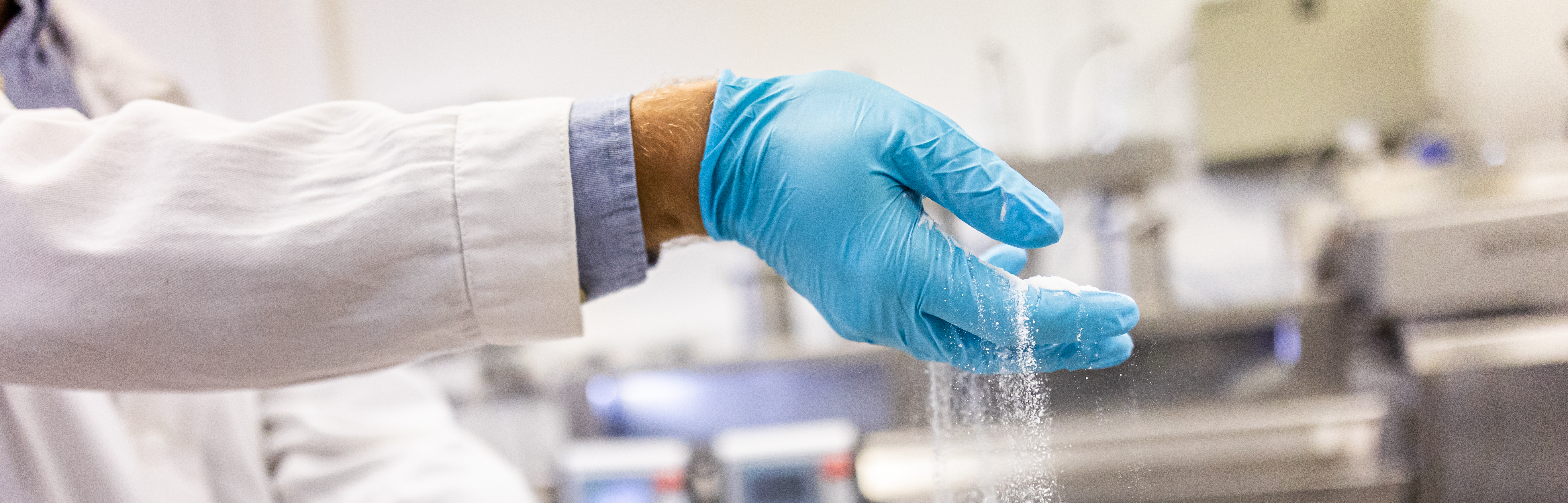
One of the most important directions of pharmaceutical research of the following years is the transformation of the traditional batchwise structure of the pharmaceutical production to continuous technologies. Using continuous processes, a faster, more flexible, and more cost-effective production structure can be developed with a higher level of drug product quality assurance. In the FirePharma Research Group we study every technological step following drug substance manufacturing from crystallization to tableting. Both batch and continuous technologies are developed to compare the processes of different nature. Furthermore, the integration of the technological steps is carried out in our laboratory to study the continuous production lines of the future.
Amorphous solid dispersions
Preparation of amorphous solid dispersions is a widely used formulation strategy to increase the dissolution of poorly water-soluble active pharmaceutical ingredients. During our researches, we are dealing with both solvent methods (e.g. electrospinning, film-casting, spray-drying) and melting methods (e.g. hot-melt extrusion). Besides the key dissolution tests, thermal analysis of the prepared samples with various analytical tools and investigation of the morphology are also important steps of our developments.

Electrospinning
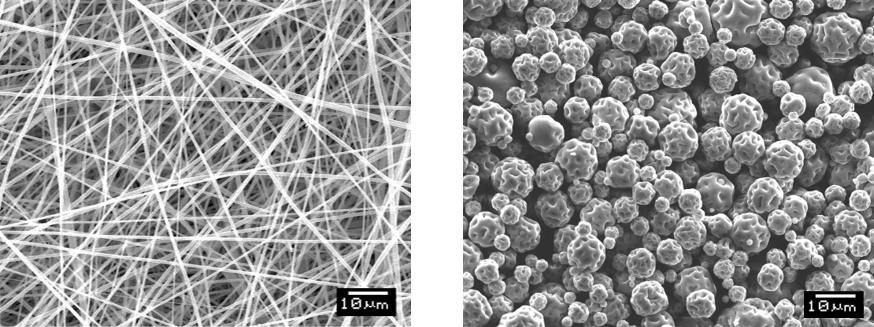
Electrospinning is a fiber/particle production method utilizing electrostatic forces for atomization and solvent evaporation. We developed high-speed electrospinning, a scaled-up technology that can be used to increase the bioavailability of poorly soluble drugs by creating (nano)amorphous solid dispersions. High-speed electrospinning could also be used as an alternative to traditionally used drying technologies (freeze and spray drying) as it enables the drying of sensitive APIs (e.g. proteins, whole cells) at room temperature.
Melt extrusion
Hot-melt extrusion is one of the most common methods in the pharmaceutical industry for preparing amorphous solid dispersions. In our laboratory, we are working with different size twin-screw extruders, which enables the continuous manufacturing of the drug-loaded extrudates with high productivity. Our researches in this field focus on the dissolution enhancement of the crystalline active pharmaceutical ingredients and the continuous technologies coupled with the appropriate in-line applicable, non-destructive analytical tools.

Blending
Powder blending is a critical step in solid drug manufacturing to achieve proper uniformity in the following operations and pharmaceutical grade content uniformity in the drug product. We are studying the implementation of the continuous powder blending to integrated manufacturing lines, by using multifunctional equipment. Blending performance is limited by the accuracy of the gravimetric feeding setup. Therefore, we study the feeder accuracy by testing the appliable feeders and the in-line analytical tools for monitoring. The monitoring is utilized in residence time distribution model building to understand the smoothing effect of the axial dispersion on the feeder disturbances.
Granulation
Granulation is an essential particle size enlargement step during drug product manufacturing (i.e. formulation) to improve the powder properties e.g. flowability required for tableting. In our laboratory we develop wet, dry and melt granulation processes mainly using continuous twin-screw devices. During our research work with different material systems we study the effect of the different process parameters on the product quality, develop in-line PAT analytical tools to monitor the process in real-time, and compare the result of continuous operation to traditional batch production.
Crystallization
Precisely controlled tank reactors are used to study the crystallization of the active compounds either in a batch or in a continuous manner. Novel plug flow systems with impinging jet mixing solutions were developed as an alternative of the more traditional stirred tank systems. More details about our research work in the field of pharmaceutical crystallization can be found here.
Tableting, film coating
When the popularity of pharmaceutical formulations among patients is considered, the dominance of tablets is unquestionable. They can be conveniently stored and administered without pain, while often their taste is also pleasant.
Integrated formulation
Besides the investigation of the continuous implementation of the different pharmaceutical technologies, the paradigm shift of pharmaceutical production requires research regarding the connectability of the technological steps. The advantages of continuous processes can take effect spectacularly only in such integrated, uninterrupted systems. The integration of the technological steps is carried out in our laboratory to study the production lines of the future.
Analytical tools
The analysis of the materials is carried out by various analytical tools in our laboratory. Differential scanning calorimetry, thermal gravimetry, polarized light microscope, Raman spectroscopic mapping, and infrared spectroscopy are used for the identification of crystal structure. HPLC, GC and CE are applied for purity and content measurement. Equipment are available for the measurement of bulk and tapped density, powder flowability, tablet strength, and friability. Standard in-vitro dissolution apparatus and combined dissolution-permeation devices are used for final dosage testing equipped with UV-Vis spectroscopy.
Referenced Publications
- D. Vadas et al., "Application of Melt-Blown Poly (lactic acid) Fibres in Self-Reinforced Composites", Polymers, 2018
- T. Vigh, B. Démuth, A. Balogh, D.L. Galata, I. Van Assche, C. Mackie, M. Vialpando, B. Van Hove, P. Psathas, E. Borbás, H. Pataki, P. Boeykens, G. Marosi, G. Verreck, Z.K. Nagy, Oral bioavailability enhancement of flubendazole by developing nanofibrous s