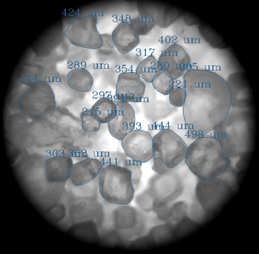
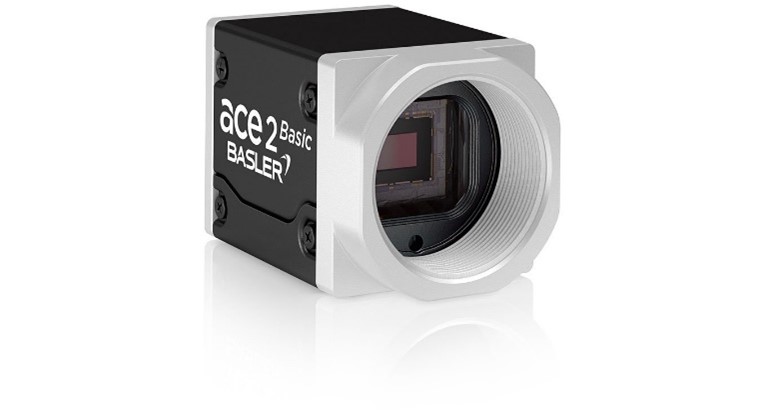
Machine Vision can be used to measure several important quality attributes in the pharmaceutical industry, e.g., particle size, API content, morphology, mass flow, etc. Our research group focuses on the following areas:
Particle Size Measurement
Particle size is important regarding both powder processability and drug release as well. Hence, real-time obtained particle size data can serve as a valuable asset to control product quality. Image analysis can provide real-time particle size data in a wide range of pharmaceutical processes: crystallization, granulation, drying, milling, etc.
Mass Flow Measurement
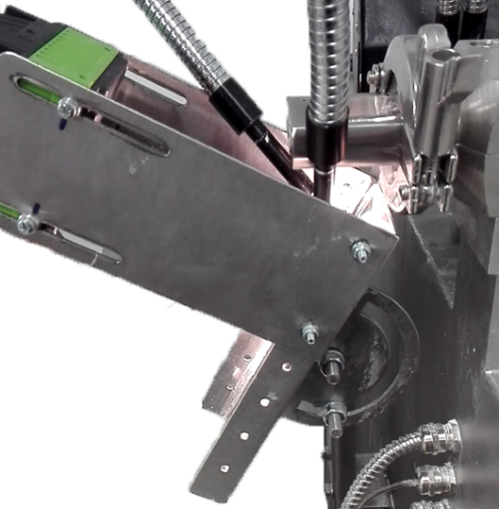
Continuous processing requires steady material feeding in order to maintain steady-state operation. Pharmaceutical continuous processing involves the use of gravimetric feeders in order to feed powders with a constant mass flow. However, feeding in the few g/h magnitude is a challenging task. Image analysis can also be applied for low-dose powder mass flow measurement: by seeing and analysing every particle, this technique can be applied for high-precision, low mass flow powder feeding.
API Content Measurement
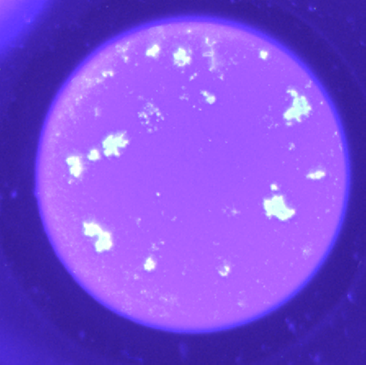
If a white API and white filler material is mixed together, machine vision may not be able to distinguish between the two materials. However, if an UV light source is shone onto a powder mixture, and the API is UV-active, like meloxicam, it shines yellow, making it easy to separate from the powder mixture. This can be used to monitor API content in a powder mixture.
Tablet properties
An experienced eye can easily tell the difference between a well-compressed and a poorly compressed tablet, as the surface roughness is different. A camera backed with proper image analysis algorithms is also capable of accurately measure parameters like compression force and crushing strength just from an image of the tablet.
Artificial intelligence
Traditionally, image analysis was carried out with simple image analysis tools: binarization, feature extraction, etc. However, in the past decade, AI-based segmentation made the use of image analysis viable in extreme conditions, where traditional image analysis would fail (batch granulation, crystallization, etc.). These processes require smart, adaptive algorithms in order to identify individual particles from their background. However, this is a rather difficult challenge: aside from the complex mathematics, these models usually have to be hand-trained, meaning they require human input to learn. But with proper knowledge, these techniques can deliver stunning results.